Category Archives: Presentations and workshops

What is Trauma? Building our Resilience

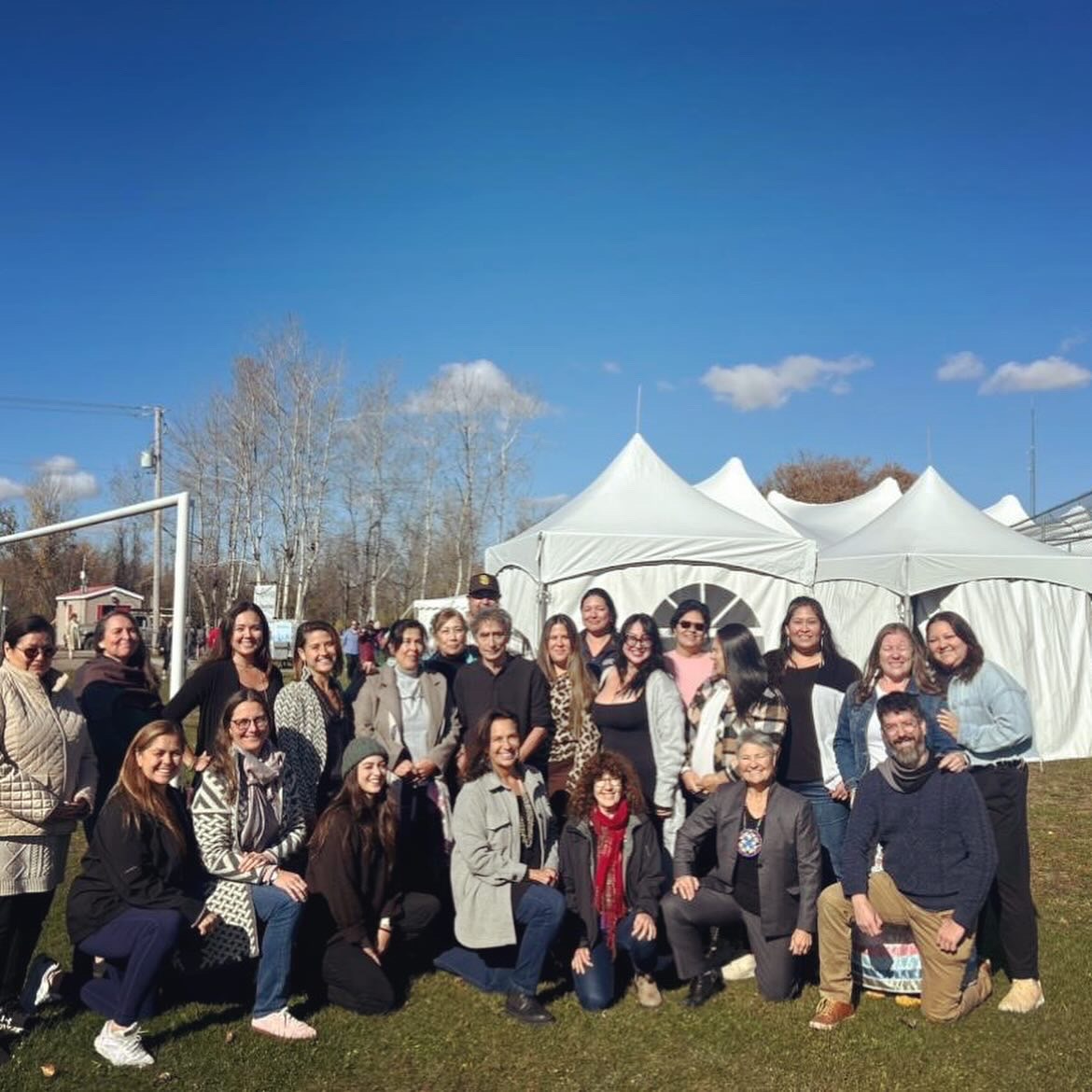
After 2.5 years of working together, our Trauma Training Team finally presented our first two-day conference in October 2024 for our community filled community led workshops that focused on challenges we face: colonial trauma, attachment wounds, shame, lateral violence and grief. This was closed by a visit by Dr. Gabor Mate on our territory! I feel grateful and proud of our team! I feel the momentum of healing a comin’!

My group presented on the connections between shame and lateral violence in communities as a by product of multigenerational and colonial trauma. All of our workshops are rooted in experiential learning and ceremony, where your affective and felt emotions act as teachers around a certain subject with our traditional ways of healing integrated to support integration.

Stepping into the Circle: Key Note for the 2024 Annual Canadian Art Therapy Conference

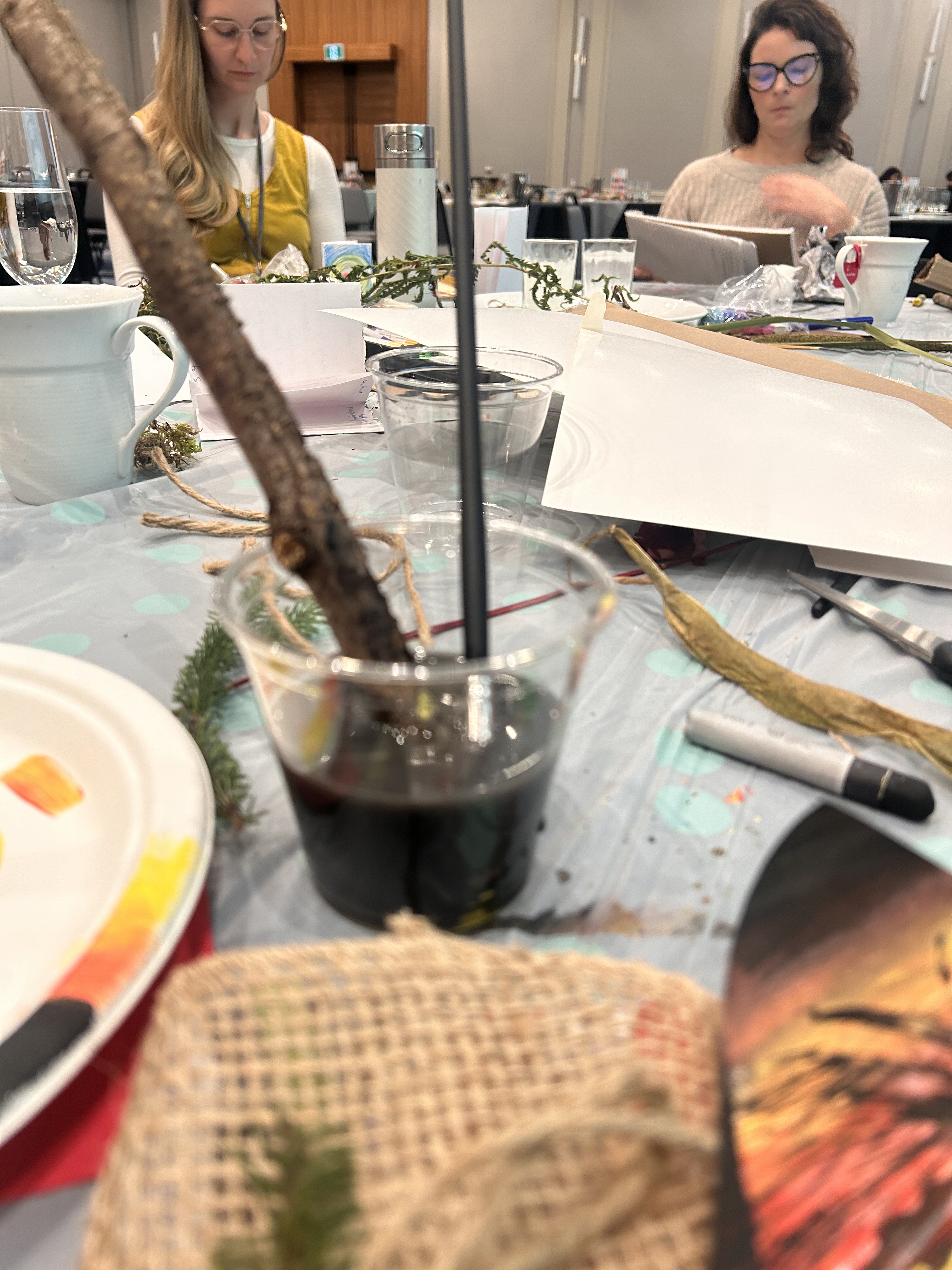
I am proud to have been part of something amazing this weekend. Haley and I were invited to Key Note this year’s Canadian Art Therapy Conference in Thunder Bay for our work on creating an Anti-Oppressive Issue for the Canadian Art Therapy Journal. This year’s theme revolved around inclusion and what we shared was that in order to talk about inclusion, we have to talk about oppression and the impacts of colonialism on indigenous people and other BIPOC communities. We have to talk about why trust is hard. We have to talk about how critical creating brave spaces is so we can authentically connect; how important it is to name, give and hold space for the hard truths in the room so that we stop performing awareness (especially since tomorrow is the National Day of Truth and Reconciliation). We dove into what a trauma-informed approach is in systems, approaches and policy through an art-making experiential together and then explored how the art therapy community can help us to create more circles. The more choice, voice and empowerment spaces we create, the more light we shed on healing.

Youth Installation Piece

Over the summer 2022, both myself and Photographer Dayna Danger collaborated with POP Montreal and LOVE (Leave out Violence Everywhere) to facilitate an arts-based experiential for youth. Focused around the theme of climate justice and the intersections between land/body, the young people came together to create a narrative that explored their past, present and hopes for the future in terms of rebuilding relationships with the land.

Exhibition of their stores was held in September during Montreal’s POP festival. Sending out big auntie love for all the young people in our creative community!

Indigenous People’s Day Intergenerational Mural

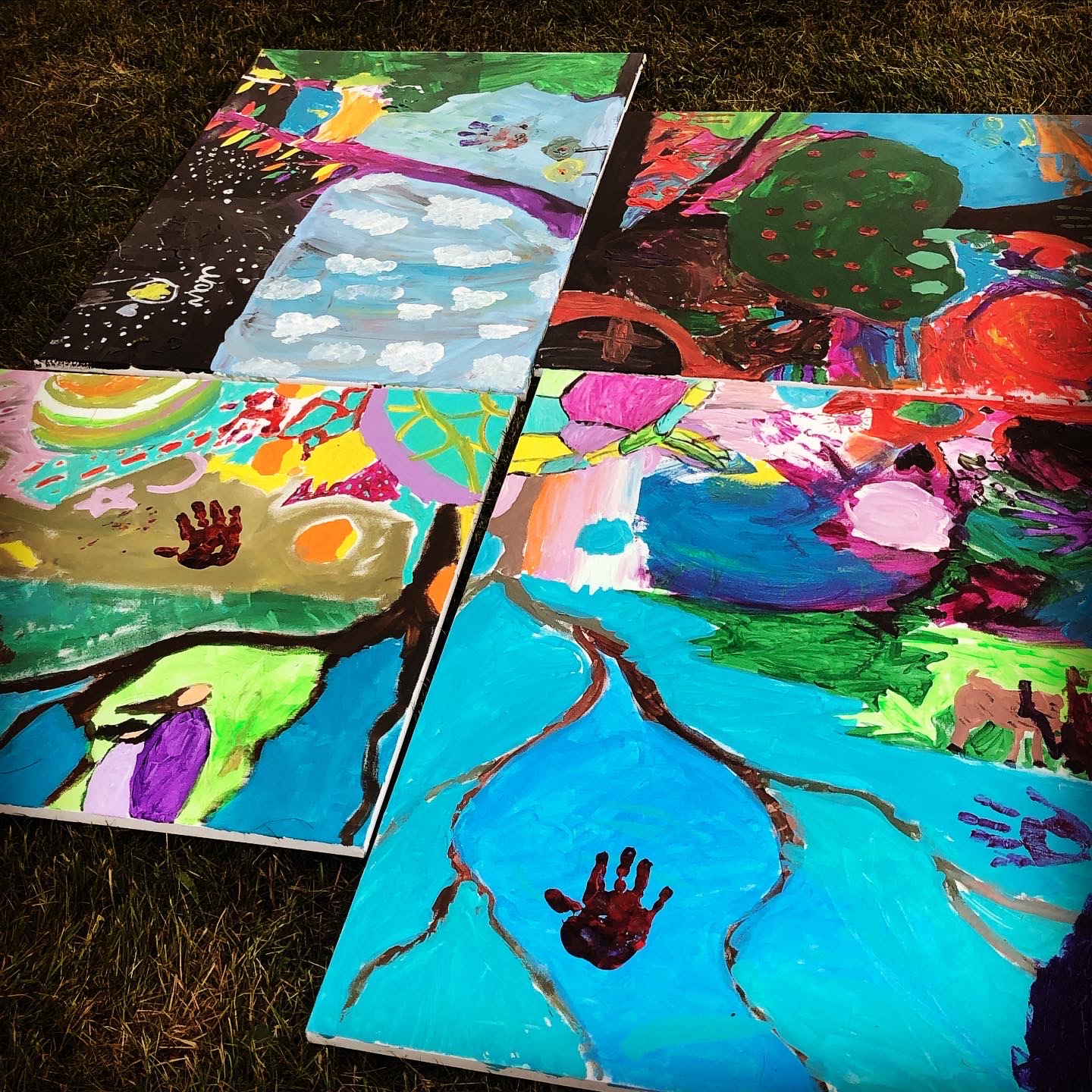
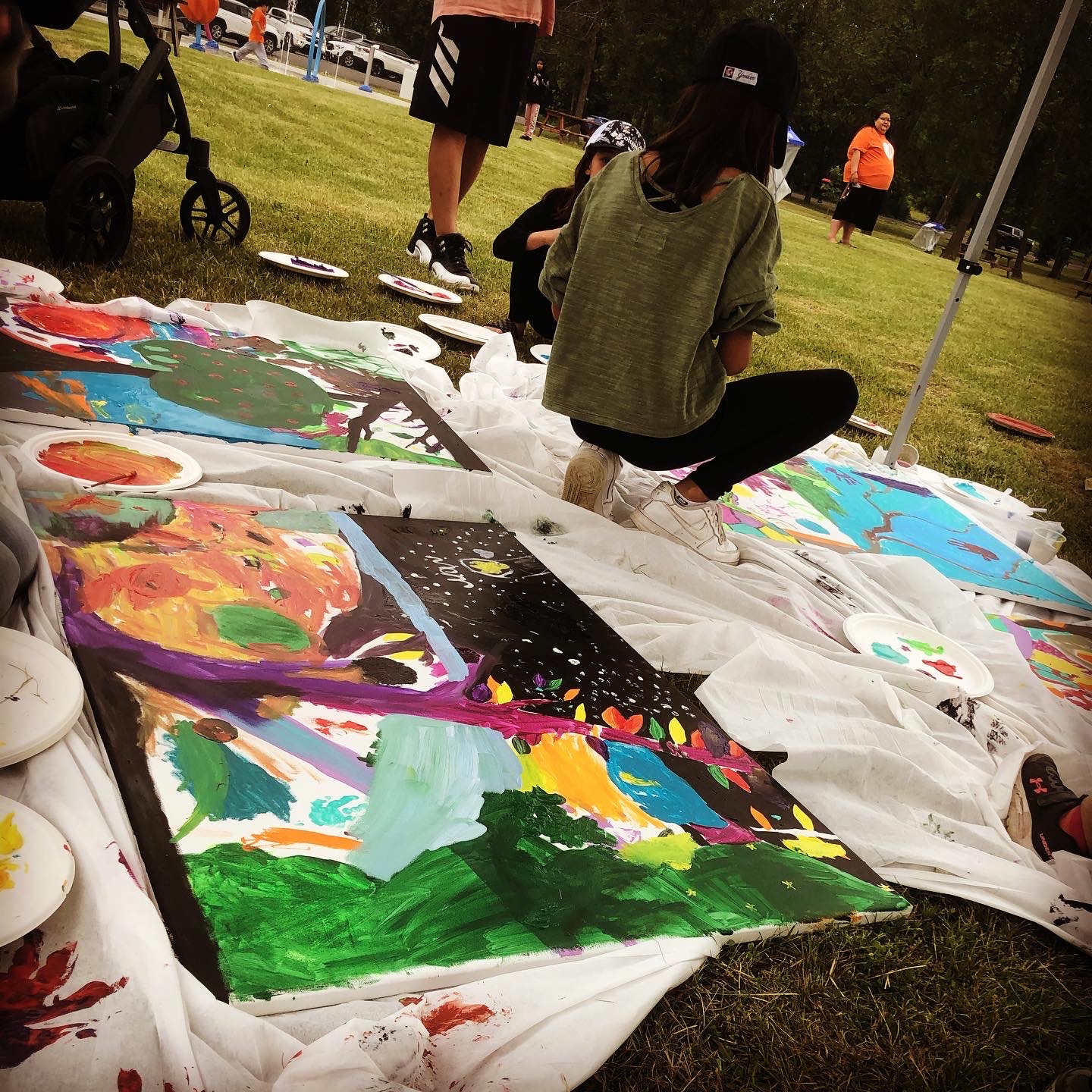
As part of the Indigenous People’s Day Block Party on July 21st 2022, organized by the Kanien’keháka Onkwawén:na Raotitióhkwa Language and Cultural Center, I facilitated a drop in mural for participants of all ages. The theme explored focused on celebrating who we are as Indigenous people. From children, teens to adults and families, dozens of community members contributed a small portion to this four part mural.

Once completed for the day, all four canvases were connected through black lines that I intended to use in weaving the narratives and energy of all the participants. This artwork was later displayed during the Iontkathóhtha’ Art Show in October 2022.

Youth Mural

In collaboration with POP Montreal and L.O.V.E. (Leave Out Violence Everywhere), I facilitated a group of youth to design, paint and complete a bin mural for Montreal’s 2021 POP festival.

The story they wish to share was the importance of honouring mental health during the pandemic.

Community Response Art to Residential Schools

On June 7th and 9th, the students and staff of Kateri School participated in a school wide mural to honor the children found in Kamloops, the children yet to be found and themselves. Both on-site students and remote learners were invited to either place a hand print on the canvas or submit a handprint to be sealed onto the painting. Kanienkeha’ka First Nations Art Therapist and 3rd Generation Residential School Survivor, Megan Kanerahtenhá:wi Whyte (MA, ATPQ, RCAT),  invited each class from nursery to grade 6 to either sit or stand in circles in the outdoor classroom by the school garden space. Together, we talked about Residential Schools within Canada and within our own community in Kahnawake. In this conversation, each child was reminded that they mattered and they were loved. Each staff member, who once were children as well, were reminded that they mattered and they were loved. Whether child or adult, every participant was either a great grandchild, grandchild and child of a Residential School or Indian Day School survivor. Some staff were Indian Day School survivors. This was an important arts-based response to the historical trauma of Residential Schools across Turtle Island, from Kamloops to the traditional lands of the Kanienkeha’ka in Quebec. It created a sense of community across the generations, which is integral to creating cultural safe spaces for Indigenous people. The paintings will be permanently displayed at Kateri School in Kahnawake, which was historically a Day School.  

Art has the power to heal. 

To dialogue. 

To build bridges. 

To connect. 

#everychildmatters

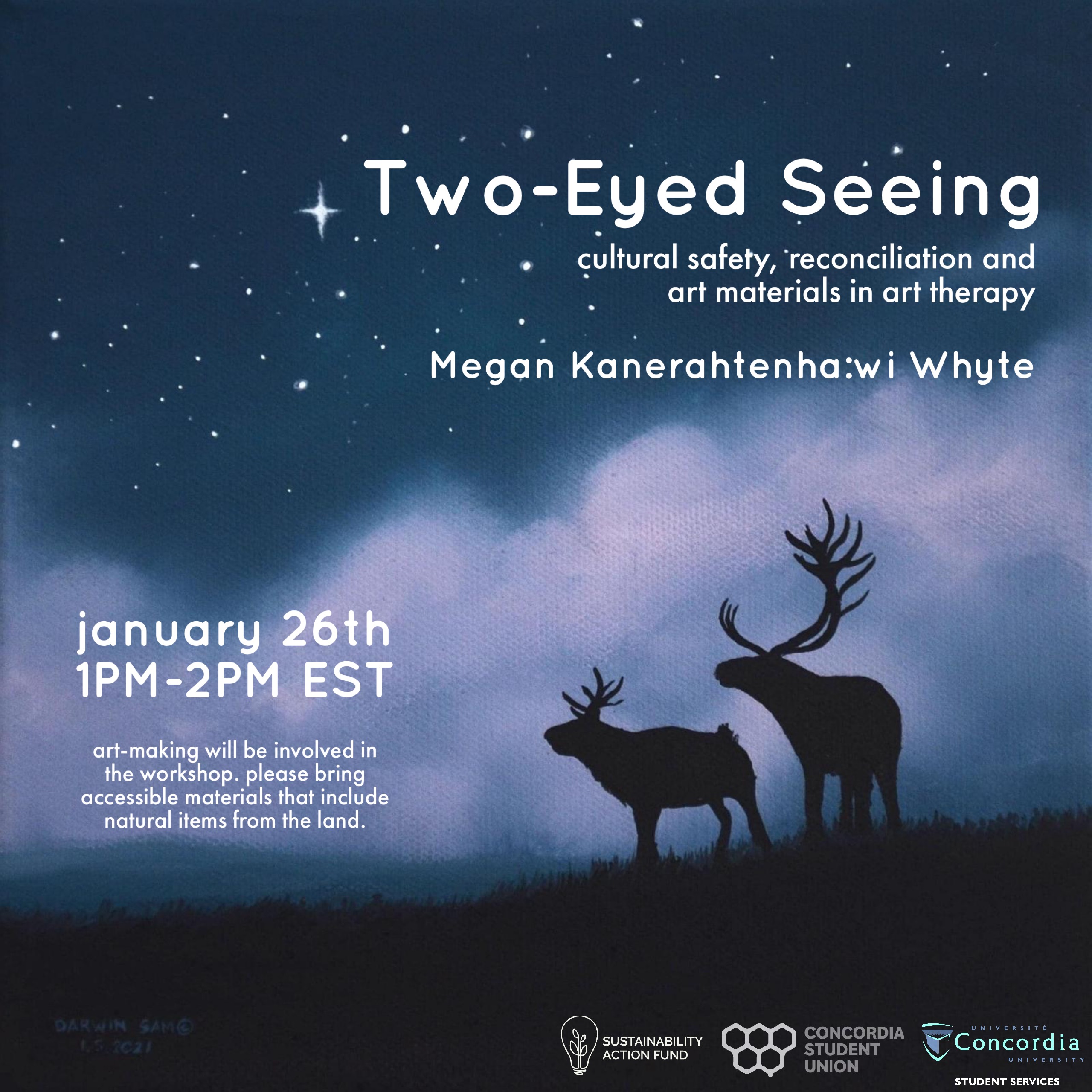
Two-Eyed Seeing Workshop: Building cultural safety and reconciliation in community spaces

Although open only to the Creative Arts Therapies students at Concordia University today, this workshop aims to develop networks, approaches and perspective for working with and as BIPOC communities. It looks at the foundations of Two-Eyed Seeing, a perspective that embodies multiply ways of knowing. It aims to create spaces of reconciliation (or rather relationship building) between communities, using both Western and Indigenous knowledges. This acknowledges the role of oppression and the importance of empowerment, which can be applied to other BIPOC communities as well.

If interested in hosting this workshop for your organization, please feel free to contact me through the contact page.

Decolonizing Consent

On September 24th 2019, I was invited to facilitate an arts-based workshop on decolonizing consent; reclaiming land and body for McGill University’s consent compaign. With support from the First People’s house and McGill’s response, education and support for sexual assault initive, this evening was made possible. Through an immersive experience,  participants were invited to create art and dialogue about environmental justice, multigenerational trauma and indigenous ways of knowing.

We, as a community, may not have change the system, extraction industries and commercialism, but we have changed the ways we have come to understand our connections between the land and body.

39th Canadian Art Therapy Association Conference

“Mending what is broken between us” was the title of the 39th Canadian Art Therapy Association Conference held at Concordia University this past October, where over 250 art therapists and allies from across Canada attended to share their knowledge and practice within the field, from research on certain intervention strategies to the ways the profession is carried through different populations.

44240876_1997269773684464_4515386477919600640_o

Pop-up art hive at Concordia university. Photo by: Caroline Campeau

Art therapy, in a nutshell, is a form of expressive therapy that combines psychological knowledge with art media knowledge to tailor services for individuals to work through their challenges in visual and often non-verbal means. As many of us may know, talking about what makes us afraid or hurt can be difficult and art can often be a way of expressing what cannot be said. The creative process, in this manner, is a place to deconstruct and reconstruct the self or an experience on both a psychological level and through the materials themselves in often surprising symbolic ways.

The role of the art therapist is to guide these individuals through their internal and creative processes using their extensive knowledge of psychological development, disorders, cognitive and affective functioning as well as a grounded knowing in how to use art media to reach psychological goals. Art therapy as a practice is thus as diverse as the colors on a pallet in the ways that it can be used, which is what tickled my curiosity as a new art therapist.

In working with Indigenous children within the school system as well as Indigenous male inmates at medium security prison, I was curious about the ways innovators were using art to create both personal and social change within the needs of Indigenous populations. Including sharing my own perspective through the presentation of my research, where I explored how multigenerational trauma impacts the identity development of Indigenous people.

Or in other words, how colonization affects how we see ourselves.

43851660_1997265290351579_8442548335356674048_o

I conducted the opening and closing ceremonies as well as presented my research. Photo by: Caroline Campeau

I found, through art material, that we exist on a spectrum of Indigenaiety (similar to acculturation in the psychology fields). This means that parts of us both accept and reject our own culture as well as the culture of on the outside because of the shame or fear or feeling not good enough (or native enough) we inherited from residential schools, family upbringing or being on a wrong side of a stereotype. Many of us have been there because many of us do not look like Pocahontas and many of us also like going to the movies, driving a car or going to university in a colonized institution.

So how we meet in the middle was what I wanted to explore.

The research I then presented was on how art materials and the creative process can act as the meeting ground for all those parts of the selves to coexist. Art-making can be the way that we can embrace two ways of knowing.

This concept, whether by chance or through social change, became the theme of “mending what is broken between us” not just in terms of our own personal struggles, but as a dialogue around reconciliation. I met with other indigenous art therapists across Canada to create a circle and dialogue that can work towards decolonizing our practice so that Indigenous people have a culturally safe place to explore themselves and have access to culturally appropriate tools—tools that may blend therapy techniques with cultural knowledge.

But decolonization rarely occurs on just one level; it has to be all levels and in this sense also involves creating a space within the profession to educate others on the impacts of multigenerational trauma and colonization on wellness so that relationships can be built to better service communities. This entails changing curriculum in our programs and educating service providers, policy makers, associations and orders and others.
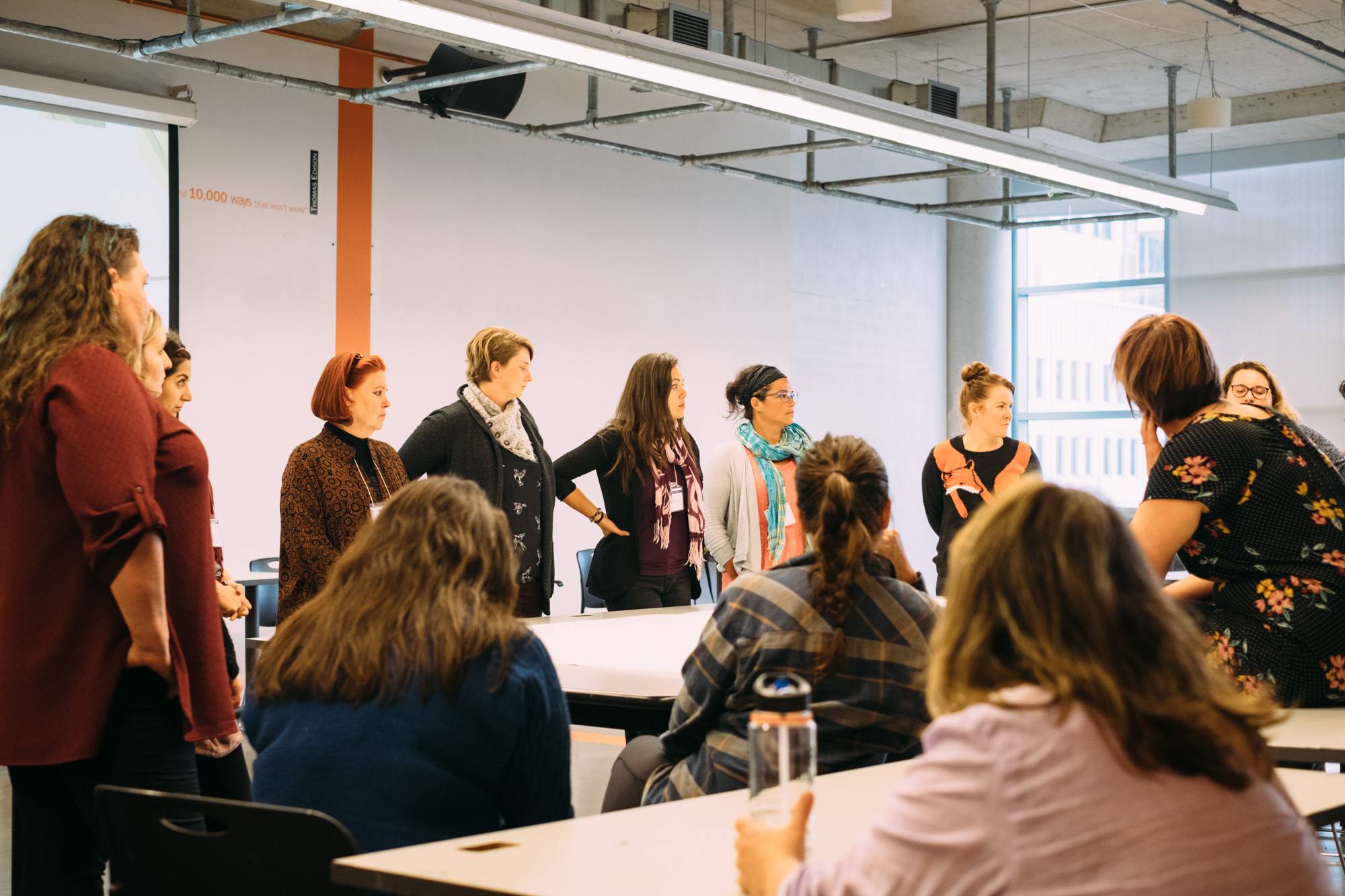
44117080_1997267433684698_2252574063144730624_o

Building framework for decolonizing the art therapy profession. Photo by: Caroline Campeau

Through building a community of Indigenous art therapists and allies, we are taking the steps to make change and by using our gifts of blending the creative process with psychology to “mend what was broken between us”.



Mouvement Santé mentale Québec Art Therapy Panel

Screen Shot 2018-05-20 at 12.54.30 PMOn May 5th 2018, I presented my art therapy research alongside a panel of creative arts therapist to promote overall wellness. My arts-based heuristic inquiry adopted an Indigenous research paradigm to explore acculturation, identity and art material interaction through the use of Mohawk First media, western art materials and the Expressive Therapies Continuum Assessment (Hinz, 2009). Through Moustakas’ six-step inquiry (1990), Hervey’s three stages of arts-based research (2000) and Wilson’s concept of land as measurement (2008), I examined my own material interaction with both western media and culturally specified Mohawk First Nation’s media as a First Nations person over a 28-day lunar cycle, noting emotional, cognitive and other stimulated areas of functioning during the process (Kapitan, 2010). The images were examined using the ETC Use and Therapist Self-Rating Scale (Hinz, Riccardi Gotshall, & Nan, 2017) as well as image reflection through Witness Writings (Allen, 1995).

The purpose of the research was to explore how material interaction could form an assessment process of acculturative identity for First Nations populations. The findings of this research indicated that access to both Western and First Nations media within an art therapy setting can help to foster a bicultural identity status, which has been linked to wellness for Indigenous populations (Kvernmo & Heyedahl, 2002; Watson, 2009).

To read my research, please click on the following link: https://spectrum.library.concordia.ca/983681/