In March 2019, the following artwork was commissioned as part of Champlain College’s (QC) Indigenous Awareness Week. The goal was to create an image that reflected on traditional knowledge, colonization and trauma as well as the multigenerational resilience of Indigenous people.

“Multigenerational Resilience” (2019). Megan Kanerahtenha:wi Whyte. Acrylic on un-stretched canvas
Taking a Mohawk First Nation’s approach, the painting was constructed through narrative, contained in the symbol of a wampum and spread across a 3ft by 8ft canvas. The two-row wampum, to provide some background to this symbol, was a historic treaty agreement between the First Nations people and the Crown that stated that each nation was of its own way of life, living side by side.

Two Row wampum (image obtained from https://apihtawikosisan.com/2012/05/treaty-talk-with-apihtawikosisan/)
The imagery within this symbol was meant to timeline the role of colonization and its impact on Indigenous wellness, including how genocide, missing and murdered Indigenous women, legislative violence and Residential schooling led to multigenerational trauma as well as outstanding socio-economic marginalization. The wampum symbol within the current societal context thus reflects the social commentary on the poor state of ‘nation-to-nation’ dialogue with Indigenous communities. The mural also acts to reflect the multigenerational wisdom and resilience of Indigenous people through the ways communities have adapted to cultural safety and that ways nations stand in solidarity against injustice to land, body and culture.
This mural now permanently resides at the Champlain College in Quebec as a conversation piece among its students. Reconciliation begins with dialogue.

Mural displayed at Champlain College.


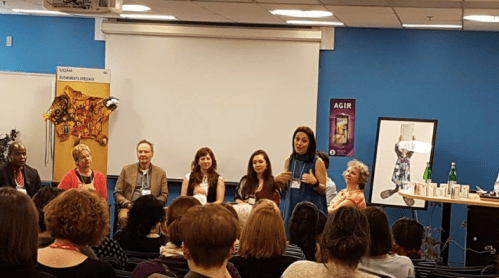 On May 5th 2018, I presented my art therapy research alongside a panel of creative arts therapist to promote overall wellness. My arts-based heuristic inquiry adopted an Indigenous research paradigm to explore acculturation, identity and art material interaction through the use of Mohawk First media, western art materials and the Expressive Therapies Continuum Assessment (Hinz, 2009). Through Moustakas’ six-step inquiry (1990), Hervey’s three stages of arts-based research (2000) and Wilson’s concept of land as measurement (2008), I examined my own material interaction with both western media and culturally specified Mohawk First Nation’s media as a First Nations person over a 28-day lunar cycle, noting emotional, cognitive and other stimulated areas of functioning during the process (Kapitan, 2010). The images were examined using the ETC Use and Therapist Self-Rating Scale (Hinz, Riccardi Gotshall, & Nan, 2017) as well as image reflection through Witness Writings (Allen, 1995).